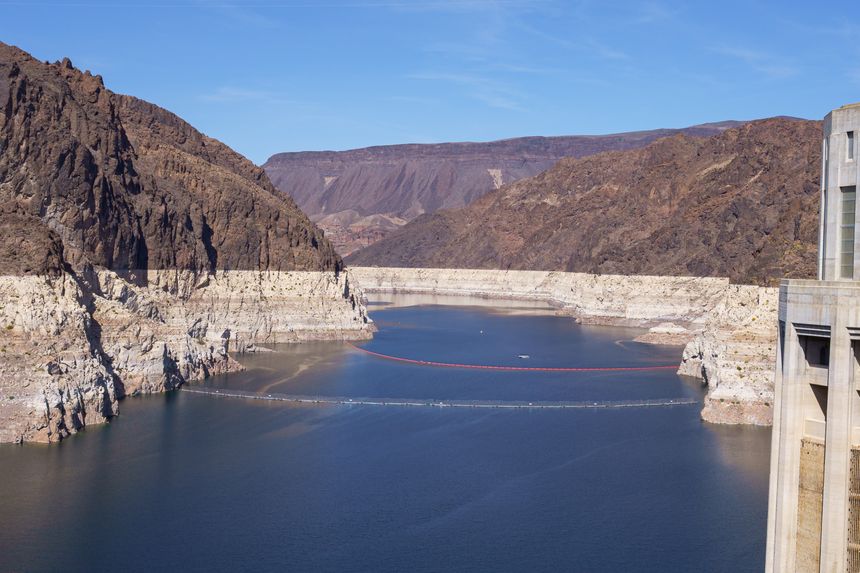


The Colorado River Basin supplies roughly 40 million people, 5.5 million acres of farmland, and critical ecological resources across seven states and Mexico. The severity of the current crisis has dominated recent headlines: several key governing documents expire at the end of 2026, including the 2007 Interim Guidelines, the 2019 Drought Contingency Plans, and related agreements with Mexico. Meanwhile, the River faces historic low-water conditions driven by prolonged drought and record-low snowpack from the 2025 winter.
The Bureau of Reclamation—the federal agency within the Department of the Interior responsible for managing water operations, infrastructure, and delivery on the Colorado River—has announced that "rather than adopt[ing] long-term operating guidelines of the same duration as the 2007 Interim Guidelines," it is proposing "to adopt an operational strategy consisting of an adaptive decision framework to develop operating guidelines for Lake Powell and Lake Mead for operating years 2027 through 2036." The stated goal is to create a flexible system that can respond to changing hydrologic conditions and incorporate future consensus recommendations among the Basin States, should such consensus be reached.
Key provisions of the Preferred Alternative include:
Two-year operating guidelines. Under the 10-year decision framework, Reclamation will develop and issue operating guidelines governing the operations of Lake Powell and Lake Mead for anticipated two-year intervals, unless a consensus-based agreement among the Basin States provides for a longer duration. Each set of guidelines will be adopted through a decision document published in the Federal Register and implemented through Annual Operating Plans.
Four operating principles. Operating guidelines developed under the framework must be consistent with four operational principles: (a) operations must be responsive to hydrology, including annual and mid-year adjustments to account for evolving conditions; (b) critical federal infrastructure must be protected, with heightened response measures triggered when Lake Powell is projected to fall below elevation 3,500 feet or Lake Mead below elevation 1,000 feet; (c) guidelines must implement the Long-Range Operating Criteria while providing objective criteria for operating under low reservoir conditions, including temporary measures beyond the Long-Range Operating Criteria where necessary to protect infrastructure; and (d) guidelines must prioritize consensus-based recommendations from the Basin States where they can be achieved.
Operational sideboards. Reclamation identified five operational sideboards establishing key thresholds and ranges within which future operating guidelines must be developed:
- Lower Basin Shortage Guidelines: up to 3.0 million acre-feet (maf) of shortage allocated to the Lower Basin to protect critical infrastructure at Hoover Dam, with allocation governed by applicable law (including the Consolidated Decree) absent voluntary arrangements among entitlement holders.
- Coordinated Reservoir Operations: Glen Canyon Dam releases ranging from 5.0 to 12.0 maf per water year, calibrated to protect critical infrastructure at Glen Canyon Dam and avoid spill-avoidance releases.
- Storage and Delivery of Conserved Water: storage of up to 3.0 maf in Lake Powell and up to 8.0 maf in Lake Mead, supporting existing and new conservation, exchange, and storage mechanisms.
- Lower Basin Surplus Guidelines: up to 500 thousand acre-feet (kaf) in additional surplus deliveries, on top of Flood Control and Quantified Surplus releases.
- Additional Activities Above Lake Powell: no mandatory Upper Basin reductions, but an opportunity for voluntary Upper Basin conservation contributions of up to 200 kaf per year, subject to hydrologic conditions, together with potential releases from the CRSP Upper Initial Units within their existing Records of Decision to protect infrastructure at Glen Canyon Dam.
Notably, while the Lower Basin Shortage Guidelines sideboard caps shortages at 3.0 maf, the modeling assumptions underlying the “Representative Preferred Alternative”—the illustrative scenario Reclamation used to analyze potential impacts—reflect shortages of up to 3.6 maf once assumptions regarding reductions in deliveries to Mexico are layered in.
The full Environmental Impact Statement can be found here.
The immediate next step will be the release of the operating plan for 2027 and 2028. This is expected to be released in the coming weeks, ahead of the mid-August deadline.
It is possible the government could adopt the Lower Basin proposal, which calls for Arizona, California, and Nevada to conserve over 3.2 million acre-feet of water in Lake Mead over a two-year period.